
How to Take Time Off as a Freelancer

Sophie Allen
Customer Success
February 26, 2026
As a freelancer, time off does not happen automatically. There is no HR department reminding you to use your vacation days, and there is no paid leave built into your contract. If you do not actively plan and track your breaks, they often disappear. But taking time off as a freelancer is not a luxury. It is essential for your mental health, your productivity, and the long-term success of your business. This guide explains why freelancer time off is different, what happens when you skip it, and how to manage your PTO in a way that protects both your income and your well-being.
Why Taking Time Off Is Different for Freelancers
Employees usually have structured vacation policies, paid leave, colleagues who can cover urgent tasks, and clearly defined working hours. Freelancers operate in a very different environment.
As a freelancer, your time off usually depends on your own planning and systems:
- You are your own backup. If you do not work, nothing moves forward unless you build coverage.
- Your time off is self-funded. No paid vacation means you need a financial plan for non-billable days.
- Clients may assume availability. Without clear boundaries, they may expect fast responses at any time.
- Flexibility can become a trap. It is easy to postpone rest from one project to the next.
Because of these differences, freelancers need a deliberate time-off strategy. Without one, breaks rarely happen consistently.
The Mental Health Impact and Why Freelancers Hesitate to Take Time Off
Most freelancers know that breaks matter, but many still postpone them. The hesitation is usually practical and professional, not careless.
When time off is delayed for too long, the impact on mental health develops gradually. You may notice you are constantly thinking about work, even outside working hours.
Over time, this ongoing mental load can lead to emotional exhaustion. Creativity drops, focus becomes harder, and small issues feel bigger than they are.
Without regular recovery, work quality can decline. Tasks may take longer, mistakes can increase, and communication may become shorter or less thoughtful.
Many freelancers avoid time off because they want to stay responsive and protect client relationships and income. But when exhaustion builds up:
- The quality of work can suffer
- Turnaround times can increase
- Patience in client communication can decrease
- Strategic thinking becomes harder
Over time, this can weaken exactly what freelancers are trying to protect: client trust, professional reputation, and income stability.
The solution is not to ignore responsibilities. It is to manage time off with structure, communication, and systems that make recovery sustainable.
Best Practices for Freelancer PTO Management
Taking time off as a freelancer works best when it is structured, not spontaneous.
Plan Your Time Off in Advance
Put planned breaks into your calendar early and treat them like fixed commitments.
When time off is visible in your annual planning, it becomes part of your business rhythm instead of something you try to fit in later.
Budget for Your Time Off
Because freelancer PTO is self-funded, financial preparation reduces uncertainty.
Building a buffer for non-working days makes it easier to disconnect without worrying about short-term income fluctuations.
Communicate Clearly with Clients
Early communication builds trust and reduces last-minute disruptions.
Inform clients about:
- Your exact dates
- What will and will not be covered
- When you will be available again
Use a Pre-Break Checklist
A simple preparation checklist helps you detach more easily:
- Finalize important deliverables
- Send short status updates
- Schedule invoices
- Set an out-of-office message
- Turn off notifications
When everything is prepared, you can disconnect with more confidence.
Protect the Break
Time off only supports mental health if you truly disconnect. If you keep checking emails constantly, your brain stays in work mode.
Define your boundaries before you leave, decide how reachable you want to be, and stick to it.
Why Tracking Your Time Off Matters
Many freelancers rely on memory when it comes to time off. The problem is simple: what is not tracked is rarely managed.
Tracking absences provides:
- A clear annual overview
- Visibility of public holidays
- Insight into how much time you actually took
- A realistic picture of your work-recovery balance
Seeing your time off across a full year helps prevent long periods without meaningful recovery and protects the quality of your work over time.
Team Absence: Structured Time-Off Management Inside Microsoft Teams
Team Absence is designed for medium to large organizations that need structured absence management directly inside Microsoft Teams, with transparency across vacations, sick leave, and other absences.
That same clarity can also benefit solo professionals. A structured annual overview of your time off is far more effective than scattered notes or loosely blocked calendar entries.
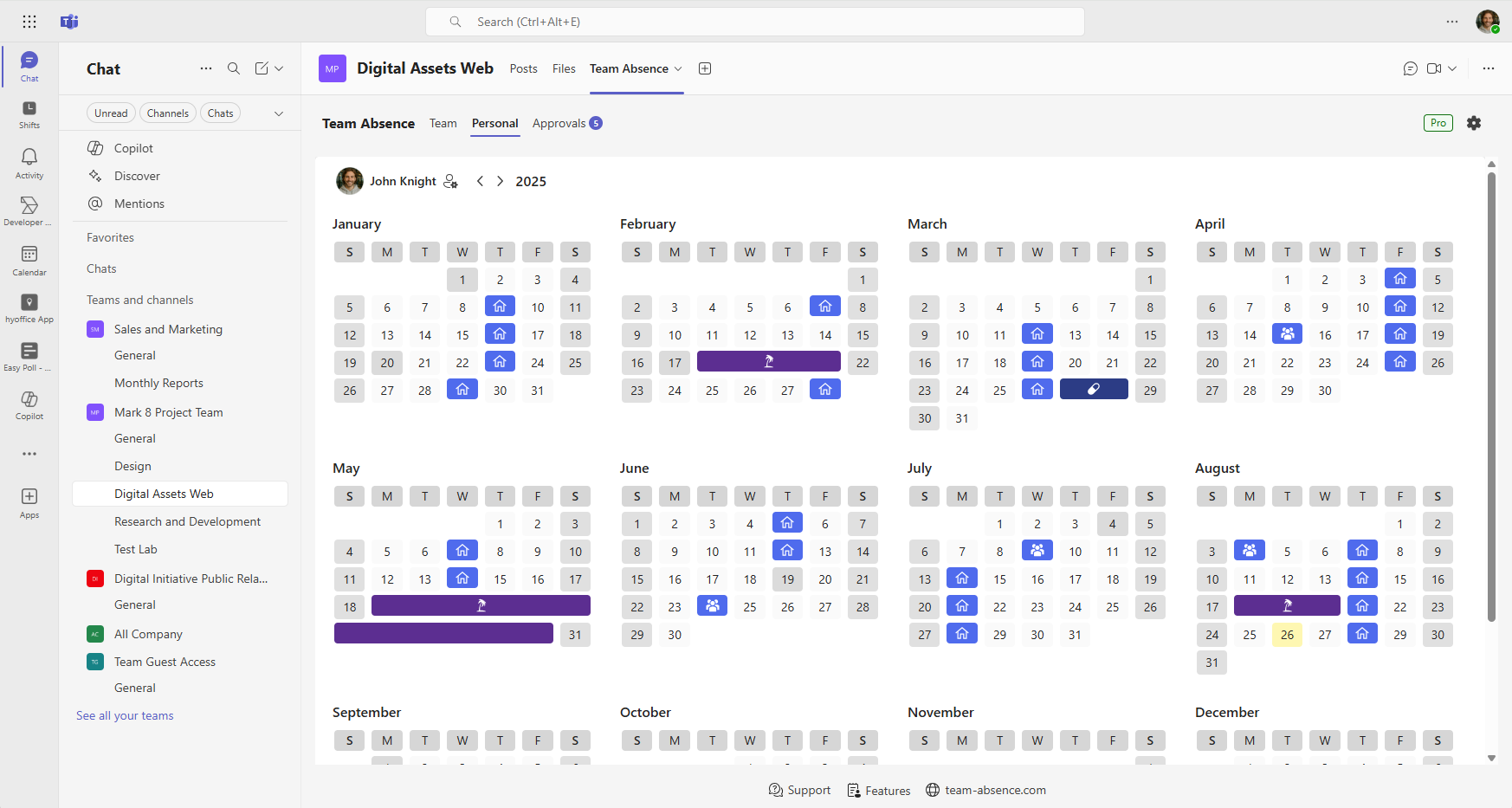
Personal View: Annual absence overview
With Team Absence, freelancers get:
- A clear yearly overview of planned and taken absences
- Automatic inclusion of public holidays
- Helpful yearly statistics
- A consistent way to track time off
In addition, Team Absence synchronizes with Outlook. When you create an absence, your calendar can be set to Out of Office automatically. This is especially useful with tools like Microsoft Bookings, where availability should reflect your time off.
 Start for free now!
 If you collaborate with clients or partners in Microsoft Teams, managing your availability inside your existing workspace keeps everything aligned. For small teams with basic needs, Team Absence is even available for free.
Do you have any questions? Please use our contact form.